Sharing
The record lives in your repository, and leaves your machine only when you send it. rb has four ways to show it:
| Command | What it writes | What travels |
|---|---|---|
rb page | One self-contained, read-only HTML file | The page |
rb open | Nothing. It serves the record live in your browser, on 127.0.0.1 only. | Nothing |
rb export | The page, a README and a hash manifest, for any static host | The page |
rb export --with-record | A bundle: the record, the files its checks read, the page and a manifest of every file’s hash | The record too |
A small record’s page, written with rb export --with-record --url:
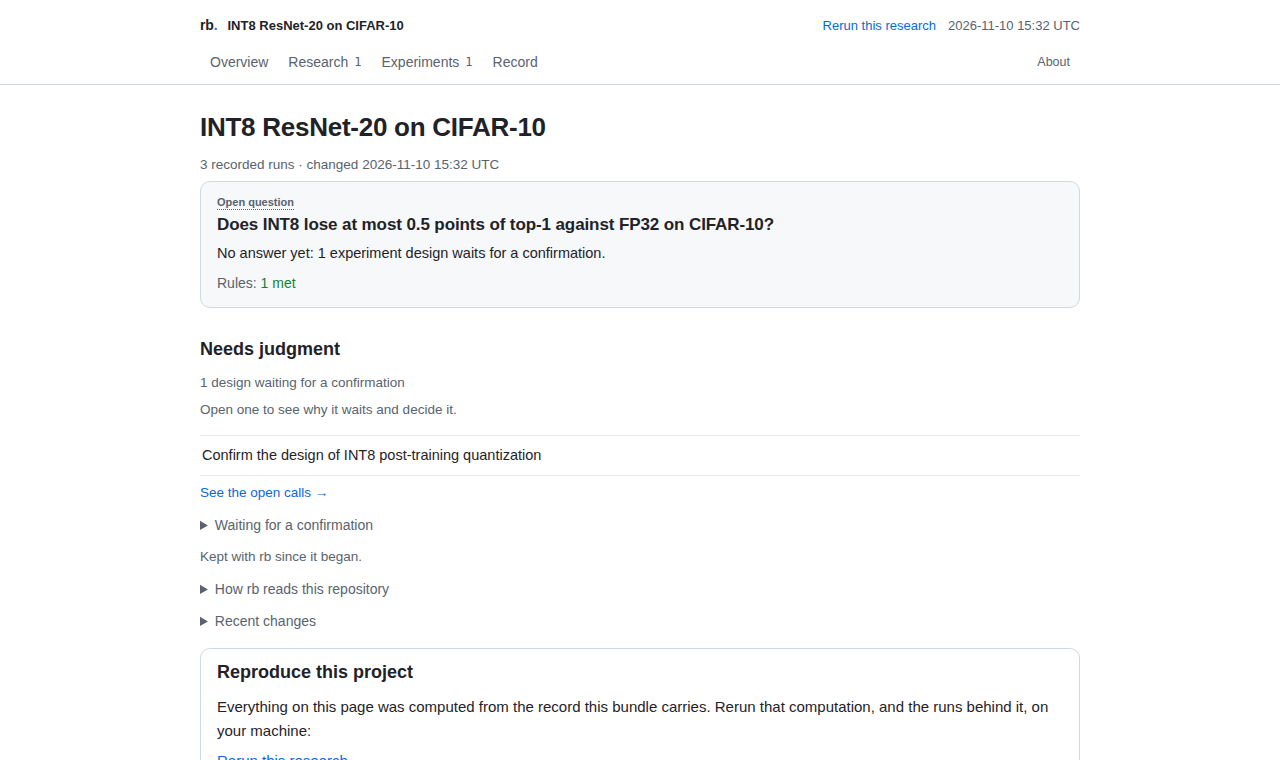
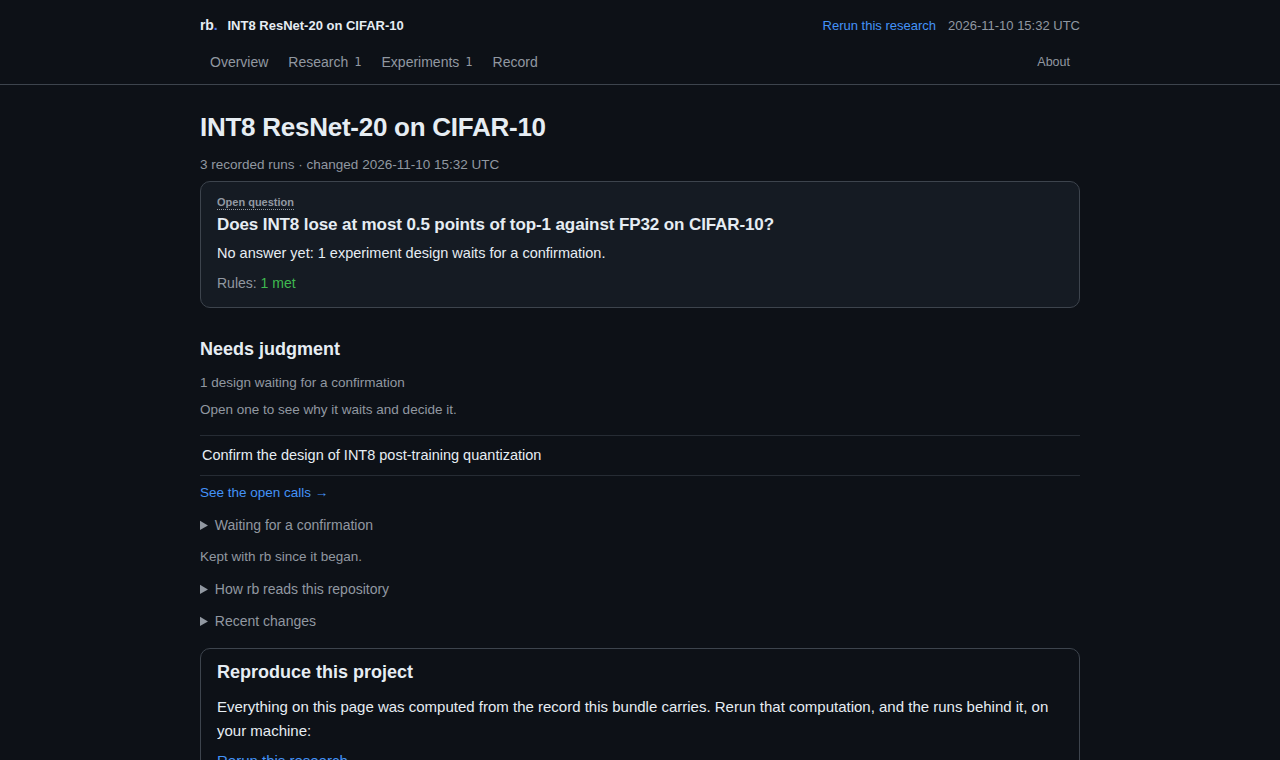
What a page leaves out
Section titled “What a page leaves out”A page names no writer, no words you gave an agent, no decision waiting for your approval, no machine platform, no branch and no path.
Which commit a page comes from
Section titled “Which commit a page comes from”A page’s About section says whether the record was committed, and at which commit. rb page, rb export and rb sync print the same line:
$ rb pagerb-page.html written: the project as one file, readable anywhere; send it to anyone.It is the record as computed now; regenerate after new runs. If it ever disagrees with rb status, rb status is right.The page says: all record files committed · at commit 2d3d23f523f2.What the record carries
Section titled “What the record carries”A bundle made with --with-record carries the whole record. rb says what that includes each time:
$ rb export --with-record --zip --out ~/int8-record.zip~/int8-record.zip written: the whole record, the page, and a manifest hashing every file.Readable without rb; rb status inside record/ reopens it. Regenerate after new runs.The record keeps who made each write (human:<name> or agent:<name>, and the channel it came through), an agent's chat session, name, version, provider and model, the user's words passed with --words, and each run's host, platform and branch. Anyone who can read the bundle can read all of it.The page says: all record files committed · at commit 2d3d23f523f2.Code repository recorded: https://example.org/ada/int8-resnet.git at 2d3d23f523f2. Pass --no-repo to leave it out.
Next: rb clone ~/int8-record.zip <dest>  ·  rb export --with-record --url <public address>   (make it publishable)
Publishing a bundle
Section titled “Publishing a bundle”rb export --with-record --url <address> writes a folder to serve at that address, with the page and the bundle.zip others clone:
$ rb export --with-record --url https://example.org/int8-resnet/ --out ~/int8-site~/int8-site written: the whole record, the page, and a manifest hashing every file.Readable without rb; rb status inside record/ reopens it. Regenerate after new runs.The record keeps who made each write (human:<name> or agent:<name>, and the channel it came through), an agent's chat session, name, version, provider and model, the user's words passed with --words, and each run's host, platform and branch. Anyone who can read the bundle can read all of it.The page says: all record files committed · at commit 2d3d23f523f2.Code repository recorded: https://example.org/ada/int8-resnet.git at 2d3d23f523f2. Pass --no-repo to leave it out.Publish the directory at the address you gave; page.html is the reading surface and anyone reproduces it with: rb clone https://example.org/int8-resnet/bundle.zipThe page’s “Rerun this research” panel holds a prompt that has a coding agent clone the record, get the code, rerun the runs and report what reproduced. Share the record, and rerun it shows a rerun from start to end.
Starting from someone else’s record
Section titled “Starting from someone else’s record”rb clone <bundle or address> <folder> starts a new line of work from a bundle. If the bundle names its code, the folder is a checkout of that code at the bundle’s commit, on a new branch rerun. Each criterion (a rule a result must meet) shows untested until your runs test it, then reproduced or not reproduced. The parent’s runs and decisions stay in the parent’s record.
A team on two versions
Section titled “A team on two versions”rb 0.8.4 saves a criterion in format 2 only when it uses one of the four more kinds of rule. rb 0.8.0 to 0.8.3 read those files as their own. rb 0.7.0 and 0.7.1 write nothing to a record with a format-2 file, refuse to clone a bundle that holds one, and say to upgrade. The record’s format says what each version does. Upgrade everyone who shares a record together.
rabbitbrain.ai
Section titled “rabbitbrain.ai”rabbitbrain.ai serves shared record pages, and sample records at rabbitbrain.ai/demo.
Make an account at rabbitbrain.ai/signin. rb login signs a machine in, and rb sync keeps a private copy of a record’s page in your account. rb sync --with-record sends the record too, so readers of a share link can rerun it. Share links are made on the site, never by rb, and can be revoked. Before rb login, rb sync says what is missing:
$ rb syncrb sync: No credential for rabbitbrain.ai on this machine. → Run rb login once per machine, or set RB_HUB_TOKEN for CI.Rabbit Brainrabbitbrain.ai · GitHub · PyPI · Privacy · Apache-2.0